The case for getting uncomfortable What cold exposure actually does to your brain and body, and how much you need to feel it
There is a reason people who cold plunge regularly describe it as addictive. It is not masochism. It is neurochemistry. The physical discomfort of cold water triggers one of the most significant and sustained neurochemical responses your body can produce without a drug, and the research backing this up is more interesting than most of the wellness content around it suggests.
Cold exposure has been used therapeutically for centuries, but the science explaining why it works has only recently become precise enough to be useful. What we know now is that deliberate cold exposure, done with the right frequency and temperature, produces measurable changes in mood, metabolism, inflammation, and stress resilience. Some of those effects last hours. Some accumulate over weeks. And critically, you do not need an ice-filled tub to access most of them.
What happens the moment you enter cold water

The visual above captures the first thirty seconds. Your body treats cold water immersion as a threat, and it responds accordingly.
The first thing most people notice is the gasp, an involuntary sharp inhale triggered by cold receptors flooding the nervous system with signals simultaneously. Heart rate jumps. Breathing becomes rapid and shallow. The skin's blood vessels constrict to protect core temperature, pushing circulation inward toward the organs. Your adrenal glands fire.
Deliberate cold exposure causes a significant release of epinephrine and norepinephrine in the brain and body. While not true of every stressor, cold exposure causes the prolonged release of dopamine, a powerful molecule capable of elevating mood, enhancing focus, attention, and goal-directed behavior.
The norepinephrine surge is nearly immediate, documented increasing by 300% or more following cold water immersion, governing arousal, attention, and the brain's readiness to act. The dopamine response is different: it builds more gradually and, crucially, remains elevated for two to three hours after you get out. This is what distinguishes cold exposure from stimulants. Coffee and amphetamines spike dopamine sharply and then crash it. Cold water raises it steadily and lets it taper naturally.
The discomfort is not incidental to this effect. It is the mechanism. The body's stress response is what triggers the neurochemical cascade, and learning to stay calm inside that discomfort, to breathe slowly when every instinct says to panic, is itself the training.
What it does for mood and depression
The connection between cold exposure and mood is where the science has become genuinely compelling, and also where it is important to be careful about overclaiming.
The neurochemical picture is clear enough. Cold exposure therapy may help reduce systemic inflammation, potentially supporting overall mental health improvement. Regular cold exposure can help regulate the balance between the sympathetic and parasympathetic nervous systems, promoting better emotional regulation.
The inflammation piece connects directly to the article we ran last month on the inflammation-depression loop. If depression is partly an inflammatory condition for a meaningful subset of people, and if cold exposure reliably reduces inflammatory markers, then the two stories intersect. The cold is not just producing a temporary neurochemical high; it may be addressing one of the underlying biological drivers of low mood.
Engaging in consistent, challenging activities that elevate norepinephrine and dopamine levels, such as cold exposure and exercise, may theoretically recalibrate the signal-to-noise ratio within fear and anxiety-related neural circuits, thereby reducing anxiety through bottom-up mechanisms.
The honest caveat is that most of the clinical research on cold exposure and depression uses small samples and short durations. The effect is real and the mechanism is plausible, but cold exposure is best understood as a complement to treatment, not a replacement for it. What it does exceptionally well is provide a reliable, repeatable, drug-free lever for mood and energy that most people can access daily.
The metabolism story: brown fat and what it means
Most people know about white fat, the kind that stores energy. Fewer know that adults also have a different tissue called brown adipose tissue, or brown fat, that does the opposite. Brown fat burns calories to generate heat. It is metabolically active in a way white fat is not, and cold exposure may activate brown adipose tissue, improve glucose regulation, reduce inflammation, and manage pain.
The interesting finding is that brown fat is not fixed. A four-week cold acclimation protocol produced a 45% increase in brown adipose tissue volume and a 2.2-fold increase in cold-induced total brown fat oxidative metabolism. In other words, regular cold exposure grows this tissue over time, making the body progressively better at generating heat and burning fuel. For anyone thinking about metabolic health, insulin sensitivity, or weight management, this is a meaningful mechanism, not a trivial one.
The calorie burn from a single cold exposure session is not enormous in isolation. But the downstream metabolic adaptation from consistent practice is a different story.
Stress resilience: the training effect
One of the less-discussed benefits of cold exposure is what it teaches the nervous system over time.
Every time you enter cold water and choose not to panic, you are running a controlled experiment in managing a threat response. The body's alarm system fires, and you practice not obeying it. Over time, this trains the neural circuits involved in threat detection and emotional regulation. Regular exposure to cold is essentially a form of stress inoculation for your nervous system. By voluntarily subjecting yourself to a controlled stressor, you train your body to manage its stress response more effectively.
Research confirms that the cold shock response habituates meaningfully after just four immersions, meaning the psychological challenge reduces while the physiological benefit is preserved. The body learns to calm faster inside the discomfort. The neurochemical reward remains.
This is why cold exposure is particularly interesting as a mental health tool. It is not just delivering chemicals. It is practicing a skill. The ability to stay composed under an acute physical stressor translates, for many people, into better emotional regulation in the rest of their lives. That is a harder thing to measure but a consistently reported experience among regular practitioners.
How much cold exposure do you actually need?
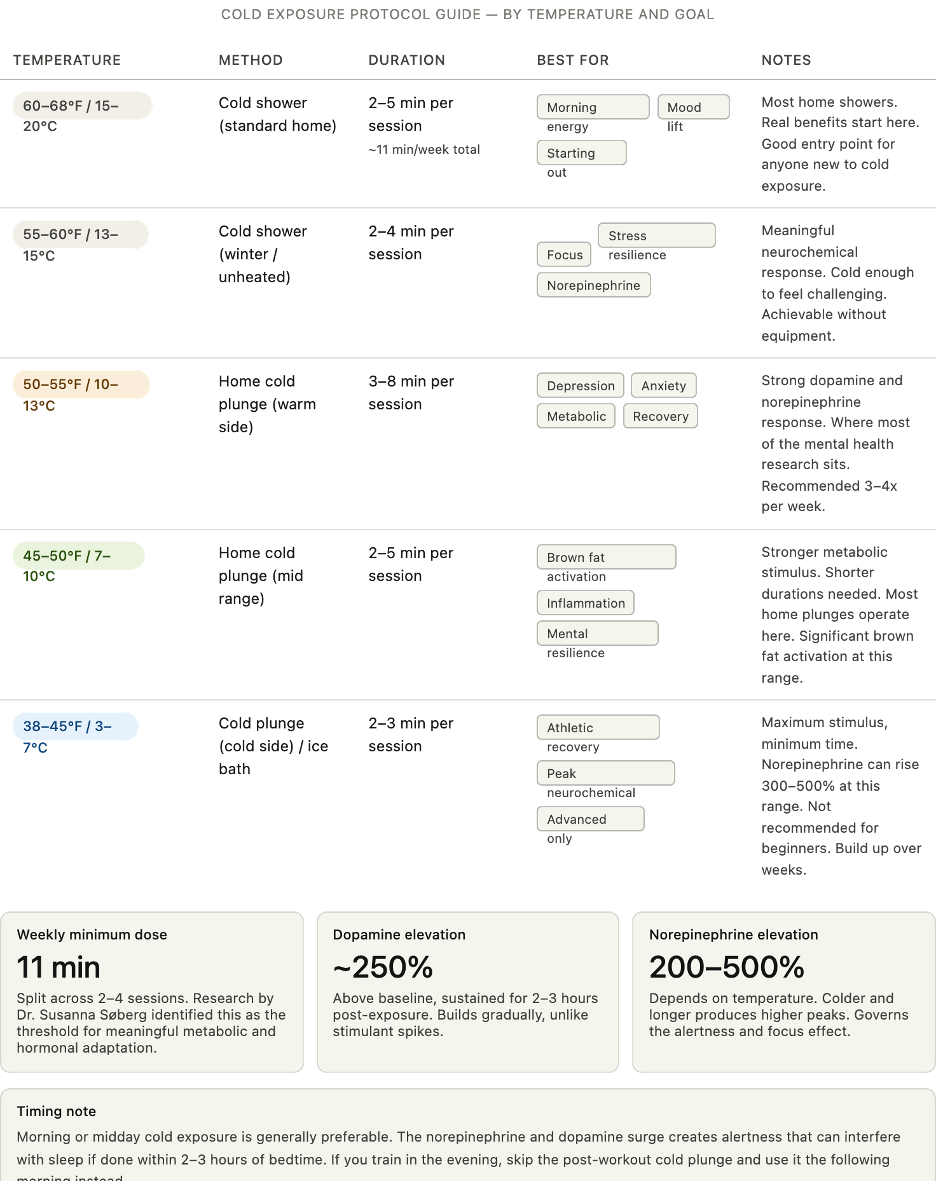
The table above maps this out by temperature and goal, but the headline finding comes from research by Dr. Susanna Søberg: 11 minutes of cold water immersion per week is the minimum effective dose for producing meaningful metabolic, hormonal, and health adaptations. That is 11 minutes total per week, spread across multiple sessions, not per session.
That is a remarkably achievable number. Three sessions of roughly four minutes each, spread through the week, clears the threshold. You do not need to be Wim Hof. You do not need an ice-filled tub.
What the temperature range matters for is intensity of stimulus. Colder water produces a stronger neurochemical response in less time. Warmer cold water, say a 60°F shower at the end of a hot one, still produces a real effect but requires longer duration to achieve it. The table above is designed to help you find the entry point that fits your setup, whether that is a standard home shower, a chest freezer converted to a cold plunge, or a purpose-built cold tub.
A few practical principles worth knowing:
Cold exposure is most useful in the morning or early afternoon. The norepinephrine and dopamine surge is activating, which is exactly what you want at 7am and exactly what you do not want at 10pm. If alertness is disrupted before bed, move the session earlier.
Do not warm up artificially immediately after. Letting your body generate its own heat after the cold is part of the metabolic stimulus. Shivering, uncomfortable as it is, is the brown fat and muscle tissue burning fuel. Jumping into a hot shower immediately after short-circuits that process.
Consistency beats intensity. Four moderate sessions per week produces better adaptation than one heroic ice bath. The stress inoculation effect, the brown fat growth, the neurochemical regulation all accrue over time with regular practice, not from occasional extreme sessions.
Start further from cold than you think you need to. Most people who quit cold exposure do so because they went too cold too fast and hated it. A 60°F shower is genuinely cold. It produces a real response. It is a legitimate starting point, and there is no shame in beginning there and progressing slowly over weeks.
The honest summary
Cold exposure is not a cure for anything. The people selling it as a universal solution to depression, obesity, immunity, and longevity are getting ahead of the evidence. But the core findings are solid: a meaningful and sustained neurochemical response, measurable anti-inflammatory effects, real metabolic adaptation with consistent practice, and a trainable stress response that appears to generalize beyond the cold water itself.
For most people, the practical question is not whether cold exposure is worth doing. It is whether the friction of starting is worth the benefit of continuing. The answer, for most people who stick with it past the first two weeks, turns out to be yes.
The threshold is lower than the influencer content suggests. Eleven minutes a week, at a temperature that is genuinely uncomfortable but not extreme, is enough to start feeling why people keep coming back.
Next: The relationship between cold exposure timing, cortisol rhythm, and sleep quality will be covered in depth in a dedicated piece on cortisol regulation.


Comments