Your Brain Runs on Energy. So Why Are We Ignoring It?

There's a question that doesn't get asked often enough in mental health conversations: what is the brain actually running on?
We talk about neurotransmitters constantly, serotonin, dopamine, norepinephrine. These are the chemical messengers that carry signals between neurons, and they're the primary target of most psychiatric medications. That framing has dominated mental health treatment for decades.
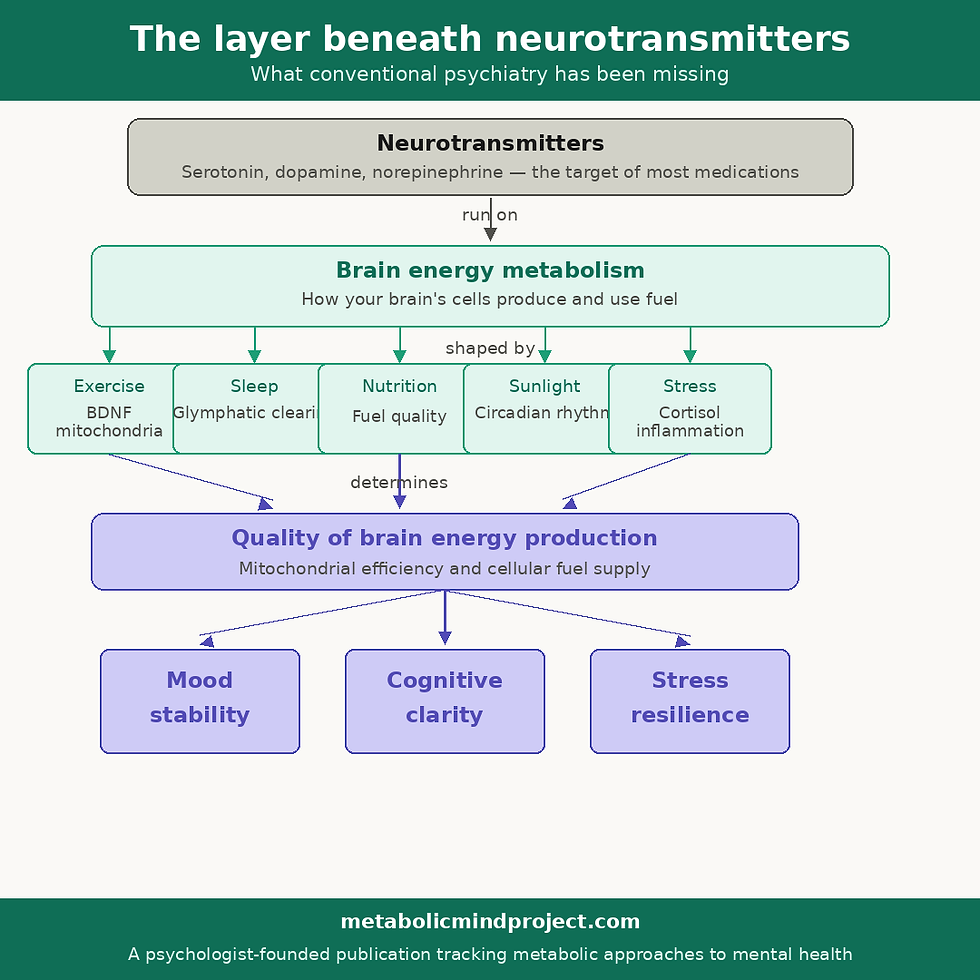
But there's another layer underneath the neurotransmitter story that most people never hear about. Before the brain can produce any neurotransmitter, before it can fire a single synapse or regulate a single emotion, it has to have energy. And the systems that produce that energy, metabolic systems, turn out to be far more relevant to how we think and feel than conventional psychiatry has recognized.
That's what this publication exists to explore.
Before the brain can regulate a single emotion, it must have energy. And the systems that produce that energy are far more relevant to mental health than we've been told.
The brain is the most metabolically expensive organ in the body
The human brain accounts for roughly 2% of body weight but consumes approximately 20% of the body's total energy output. That's not a rounding error, it's a design feature. The brain is an extraordinarily hungry organ, and it requires a continuous, stable supply of fuel to function well.
When that fuel supply is disrupted, even subtly, even temporarily, things start to go wrong. Concentration slips. Mood destabilizes. Anxiety spikes. Sleep suffers. These aren't just psychological events. They're metabolic ones.
Researchers studying brain energy metabolism have found that mitochondrial function, the cellular machinery responsible for converting fuel into usable energy, is compromised in a range of psychiatric conditions, including depression, bipolar disorder, schizophrenia, and anxiety disorders. This isn't a fringe hypothesis. It's showing up consistently in peer-reviewed research, and it's beginning to reshape how a small but growing group of clinicians think about treatment.
This isn't just about what you eat
When people hear "metabolic health," they often think diet. And diet matters significantly. But metabolic health is a much broader concept than what's on your plate.
Think about what actually determines how well your cells produce energy:
Sleep is metabolic. During deep sleep, the brain clears metabolic waste products through the glymphatic system, a kind of nightly cleaning cycle that appears essential for cognitive function and emotional regulation. Chronic poor sleep doesn't just make you tired. It impairs the brain's ability to manage its own biochemistry.
Exercise is metabolic. Physical activity improves mitochondrial function, increases brain-derived neurotrophic factor (BDNF), and has been shown in multiple studies to reduce symptoms of depression as effectively as some antidepressant medications. The mechanism isn't just "endorphins", it runs much deeper into cellular energy production.
Sunlight is metabolic. Light exposure regulates circadian rhythms, which in turn regulate cortisol, melatonin, insulin sensitivity, and a cascade of other systems that directly affect mood and cognitive performance. The link between light exposure and depression is well-established. The metabolic pathway behind it is less discussed.
Stress is metabolic. Chronic psychological stress elevates cortisol, which disrupts blood sugar regulation, impairs mitochondrial function, and promotes inflammation, all of which affect brain energy availability. The mind-body connection isn't a metaphor. It's physiology.
Cold exposure, certain supplements, time-restricted eating, breathwork, all these practices that have moved from fringe to mainstream in the last decade share a common thread: they are interventions that influence metabolic function, which in turn influences how the brain performs.
Sleep, exercise, sunlight, stress, these aren't lifestyle factors separate from mental health. They are metabolic inputs that directly affect how the brain produces and uses energy.
This isn't a story about illness
It's worth being clear about something: most of what we're tracking here isn't primarily about psychiatric diagnosis. It's about the full spectrum of how the brain performs.
The same metabolic systems that, when severely compromised, contribute to serious mental illness are the systems that, when optimized, support sharper thinking, more stable mood, better resilience under stress, and more consistent energy across the day. This is a continuum, not a binary.
You don't have to be unwell to be interested in this. You just have to be curious about what makes the brain work well, and willing to consider that the answer might involve more than talk therapy and medication.
That curiosity is growing. The conversations happening in research labs, in forward-thinking clinical practices, and in the online communities where people share their own experiments are starting to converge around a common insight: mental health is not separate from physical health. The brain is not separate from the body. And the energy systems that run everything else run the mind too.
What we're watching
The Metabolic Mind Project exists to track this emerging territory, rigorously, honestly, and early. Not to advocate for any single intervention or dietary approach, but to follow the research wherever it leads and translate it into something useful.
Some of what we cover will be established science that mainstream mental health practice has been slow to integrate. Some of it will be early-stage findings that deserve serious attention before they reach the popular press. Some of it will be cultural shifts, changes in how patients, practitioners, and researchers are thinking about the mind-body relationship, that signal something bigger is coming.
We're paying attention to all of it.
If you're a clinician who suspects there's more to explore in the metabolic dimension of mental health, you'll find this space interesting. If you're someone personally curious about optimizing how you think and feel, not because something is wrong, but because you want to understand what's possible, this is for you too.
The brain runs on energy. Understanding where that energy comes from, and what affects its quality and stability, might be one of the most underexplored frontiers in mental health today.
That's what we're here to find out.
About the Metabolic Mind Project
A psychologist-founded publication tracking the emerging science and cultural shift around metabolic approaches to mental health, before it reaches the mainstream. We publish weekly at MetabolicMindProject.com.



Comments